

Content marketing that answers the question instead of padding a word count
The industry standard is a 3,000-word article because a tool said longer ranks better. Google says the opposite: helpfulness is what it rewards. We write the shortest thing that fully answers the question, and we publish the pricing content your competitors are too nervous to touch.
No contract past 90 days · You own every account · No ranking guarantees, ever
Custom quote a number within one business day
- Steady — three pieces a month, done completely
- Engine — six pieces + the assets that earn links
- Every topic pulled from live search results, never a brainstorm
- The 90-day rewrite pass on everything we ship
What you'll notice
The short version. The whole list is underneath if you want to check that the thing you care about is on it.
- Planning
- Writing
- Assets that earn links
- On-page and structure
- After publishing
See all 30 things we do
Planning
- Topic map built from live search results, not from a brainstorm
- Guide pages and money pages separated so they never compete
- Question harvest from autocomplete, related searches and real customer calls
- Content gap analysis against the pages currently ranking
- A publishing calendar with dates, not a vague cadence
- A written brief per piece — target term, angle, and what it must answer
Writing
- Cost and pricing content, including real ranges
- Buying guides that state the trade-offs, including when the cheaper option wins
- Comparison pages between the options a customer is actually weighing
- Problem and symptom pages for the searches people make at 11pm
- Service pages written to convert, not to hit a keyword count
- FAQ blocks answering the question in the first sentence
- Case write-ups from jobs you have actually done, with your sign-off
- Rewrites of existing pages that are thin, dated or duplicated
Assets that earn links
- Original data pulled and published, with the method shown
- Calculators and estimators built as real pages
- Charts and diagrams made specifically for the piece
- Checklists and templates a reader would actually download
- Photography direction — your trucks, your crew, your work, not stock
On-page and structure
- Tail term in the title, H1 and slug; head term as an H2
- Table of contents on anything long enough to need one
- Internal links out to the money page the piece supports
- FAQ and Article schema where it applies
- Meta title and description written per page, at correct length
- Images compressed, sized and captioned
After publishing
- Sitemap resubmission and IndexNow ping on every deploy
- Index status checked rather than assumed
- Query data reviewed at 30 and 90 days
- Underperforming pages rewritten rather than left up
- Pages that are cannibalizing each other merged
What the first six months look like
So you know what month one is, rather than finding out after you have signed.
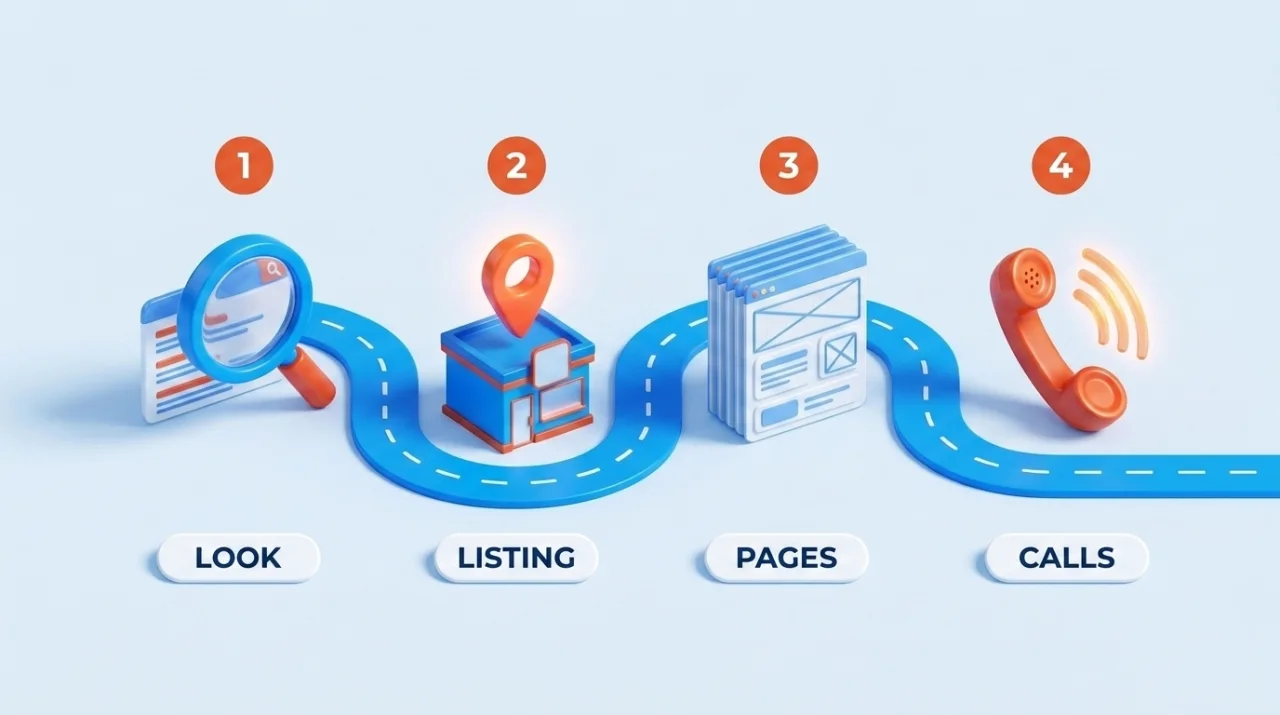
The topic map
We pull the live results for every candidate topic and sort them into two piles: queries Google answers with an article, and queries it answers with a map of local businesses. Only the first pile becomes content. The second becomes service pages.
The interview
An hour with you or your lead tech. This is where the content stops sounding like every other agency’s. What actually goes wrong on a job, what customers get wrong, what you wish they knew before they called.
Briefs before drafts
Each piece gets a one-page brief: the target term, the angle, what it has to answer, and what it must link to. You approve briefs, which is faster than approving finished drafts.
Write, review, publish
We draft, you correct anything technically wrong, we publish. Nothing goes live with a claim about your business you have not confirmed.
Submit and check
Sitemap and IndexNow on every deploy, then the index status is checked rather than assumed. A page nobody crawled is not published, it is uploaded.
Revisit at 90 days
Query data tells us what a page actually got found for, which is often not what we targeted. Pages get rewritten toward what they are already ranking for, and dead pieces get cut instead of accumulating.
Exactly what you get, at every price
Two plans. Steady is three real pieces a month, forever — the cadence that actually compounds. Engine is the full operation, pricing content and linkable assets included.
Steady
Custom request a quote
Three pieces a month that answer real questions, forever.
You want the compounding asset without the big retainer. Three pieces a month, every month, beats thirty pieces in January and silence by spring — and we have watched that exact pattern kill more content budgets than any algorithm ever did.
-
Three published pieces a month, chosen from live search results — not a brainstorm
Every topic is a question people in your market are typing right now. Nothing gets written to fill a calendar.
-
A one-page brief approved by you before a word is drafted
You correct the direction in two minutes instead of rewriting a finished article — and nothing publishes about your business that you have not confirmed.
-
Every piece built to win the specific search first, then grow into the bigger one
Most content loses both fights at once. Ours is structured the way the winners are — which is exactly why we do not publish the recipe here.
-
Internal links wired from every piece to the money page it supports
A blog post that does not push authority at a page that sells is a diary entry. Ours are plumbing.
-
Sitemap and index submission on every publish, then checked — not assumed
A page Google never crawled is not published, it is uploaded. We confirm the crawl.
-
The 90-day rewrite pass on everything we ship
Query data tells us what a page actually got found for — often not what we aimed at. We rewrite toward what is already working. Most agencies never look back. This is where the compounding comes from.
What this plan is not: No linkable assets, no photography direction, no pricing-guide program — those live in Engine. Three good pieces done completely, not eight done thin.
Start with the free auditEngine
Custom request a quote
The full content operation — including the pages that earn links on their own.
Considered purchases and contested markets, where the customer researches for a week before calling anyone and the site with the real answers gets the call.
-
Everything in Steady, at double the output — six pieces a month
Enough velocity to cover a whole topic the way Google rewards: the question, the cost, the comparison, the mistake — as a connected cluster, not scattered posts.
-
The pricing and cost content your competitors are afraid to publish
The most-searched, least-answered question in every local trade is "what does it cost." The business that answers plainly earns the call while the competition hides behind "request a quote."
-
One linkable asset a quarter — original data, a calculator, a chart worth citing
This is how a small site earns links without buying them. One good asset can out-earn a year of outreach emails.
-
The owner interview, worked into every piece
An hour of what actually goes wrong on jobs turns generic articles into content only your business could have written. That is the line between ranking and being trusted — and it cannot be faked, which is exactly why it works.
-
Art direction on every piece — real photography, charts and diagrams planned for you
Customers hire people, not templates. We plan exactly what gets shot and built for each page, so your site stops looking like everyone else’s.
-
Content rescue on what is already there — merge, rewrite, or cut
Eighty old posts competing with each other drag the whole site down. We consolidate the mess a previous agency left instead of piling more on top of it.
First five Birmingham businesses: 25% off any plan for your first 90 days.
We are new in town and we would rather prove it than promise it. The trade is simple: you get the discount, and once the work has earned it, we ask for an honest Google review and permission to publish your numbers as a case study. When the five spots are gone, they are gone.
Claim a founding spotNot sure which fits? That is what the free audit decides. We look first, then recommend a plan — and if the honest answer is the smaller one, that is the one you will hear.
More specific than "Content Marketing"
Most businesses need one or two of these, not all of them. Each one says who it is for so you can rule it out quickly.
Pricing and cost content
The most searched and least served topic in every local trade. Homeowners openly ask whether a quote is a rip-off. The business that answers plainly earns the call, and almost nobody does.
Right for you if: Any trade where customers are getting three quotes and cannot tell them apart.
Service page writing
One page per service, per city, written to convert rather than to hit a word count. These are the pages the map listing and the ads both point at.
Right for you if: You have one page called "Services" doing the job of nine pages.
Blog and guide programs
The research layer — the searches people make before they are ready to call. Built to link up into the money pages rather than to sit in a blog archive.
Right for you if: Long sales cycles, or expensive purchases people research first.
Linkable assets
Original data, calculators and diagrams built to be cited. This is how a small site earns links without buying them.
Right for you if: Anyone whose backlink profile is thin and who will not buy links.
Content rescue
Auditing what is already published, merging pages that compete, rewriting what is thin, and deleting what should never have gone up.
Right for you if: A previous agency published 80 articles and traffic did not move.
Photography and visual direction
Every piece gets its visuals planned and produced — real photography direction, charts and diagrams built per page. Your site looks like your business, not a template.
Right for you if: Every page on the site currently uses stock images.
Eight questions to ask every agency you talk to
Including us. If an answer here does not match what you get on a call with someone else, that is the useful part of this page.
Show me the live search results for three terms you would target.
Google answers some queries with an article and others with a map of local businesses. Those need completely different pages. Anyone who has looked will have the screenshots.
Bad answer: A keyword list with volume and difficulty columns and no screenshots of the actual results page.
What is the monthly search volume for my main term, and where did that number come from?
Volume comes from a paid database and should be quotable with a date and a source. It is a fact, not an opinion.
Bad answer: "Thousands of people are searching for this every month."
Who owns the website, the domain, the Google Business Profile and the analytics?
If the agency owns any of them, leaving costs you everything you built. It should all be in your name from day one.
Bad answer: Anything vague about "our platform" or "our hosting".
Do you guarantee rankings?
Google does not sell placement in organic results, so nobody can guarantee a position. The correct answer is no.
Bad answer: Yes, in any form, including "guaranteed page one" and "guaranteed traffic".
What is the minimum contract, and what happens in month one if I cancel?
SEO is slow, so long terms are defensible — but the term should be stated up front, not buried.
Bad answer: A twelve-month auto-renew you find out about at signature.
How will I know it worked?
The measure is calls, forms and booked jobs. Rankings and traffic are how you get there, not the point.
Bad answer: A monthly PDF of ranking positions with no call tracking attached.
Which of my competitors do you already work with?
An agency running three plumbers in one city is competing against itself with your money.
Bad answer: Refusing to answer.
What would you tell me not to spend money on?
Every real assessment finds something not worth chasing. An agency that finds nothing is selling, not assessing.
Bad answer: Everything is an opportunity.
The part nobody puts on the page
Content is slow. It compounds, but it does not produce calls in week two, and anyone promising that is selling you something. If you need the phone ringing this month, advertising is the honest answer and we will say so.
What people search to find this
Pulled from a paid keyword database, dated and sourced. You can check any of it.
| Keyword | Searches / mo | Demand | Difficulty |
|---|---|---|---|
| content marketing | 368,000 |
|
74 |
| content creation agency | 8,100 |
|
0 |
| seo marketing | 12,100 |
|
75 |
Source: DataForSEO · United States · 31 July 2026
Content Marketing questions
How much content do I actually need?
How long should a page be?
Do you use AI to write?
Will you publish our prices?
Who approves the content?
What if a piece does not rank?
Do you write for AI answers specifically?
Can you write in our voice?
Do we own the content?
Is a blog worth it for a contractor?
The other two services
Search Engine Optimization
Most of what gets sold as SEO is a monthly report showing positions that moved.
From Custom quote a number within one business day →
Digital Advertising
SEO compounds but it is slow.
From Custom quote a number within one business day →
Industries we do this for
Let's look at your actual results page
Tell us the work you want more of. We will pull the live search results for it and send you what we find, including when the answer is that it is not worth chasing.
I'm Terry Baker, founder of Terry Baker SEO. I have been marketing online since 1999 and I work personally with each business. Reach me directly at (205) 835-2631.